Monday, August 03, 2009

Libraries and reader privacy - critical juncture / take action

From: http://blog.librarylaw.com

Libraries have always respected reader privacy as essential to one's freedom to read. If someone is looking over your shoulder, you might not pick up that book on gay stories, witchcraft, communism or whatever the taboo topic du jour happens to be. Libraries require either patron consent or actual legal process before disclosing patron records.

Fast forward to reading books online via Google Book Search. Fabulous new life for old books, but where in the complex proposed settlement agreement between Google and the publishers are reader privacy guarantees? I'll save you the pain of looking. Nowhere.

Every time you go online, you leave digital tracks, and with the settlement, you will generally need to authenticate yourself before viewing the out-of-print but in-copyright books at issue.

The final contours are not yet set. The settlement is not yet in effect. It's time now to take action to make sure we build some privacy safeguards in. The ACLU of Northern California, the Electronic Frontier Foundation and Berkeley's Samuelson Clinic have joined in a letter to Google, requesting:

1- Protection against disclosure
2- Limited tracking
3- User control
4- User transparency

Our library users will be reading google books inside the library as well as at home/work. If a reader borrows a book from the library, we protect her privacy. If she reads the same book on our computer terminals, she needs the same protection.

Friday, July 31, 2009

Library Day in the Life...

Emily 1 min ago

A Day in the Life of a Library...

Whether you are a librarian or library worker of any kind, help us share and learn about the joys and challenges of working in a library. Join us by sharing details of your day for a week on your blog. Not only is this a great way for us to see what our colleagues are doing and how they spend their days but it’s a great way for students who are interested in the library profession to see what we really do.

  • Round 1 July 2008
  • Round 2 January 2009
  • July 27th 2009 begins the Second Annual

Don't have a blog? Feel free to add a page to the wiki with your activites!

If you are interested in sharing your day/week in the life:

  1. Create a PB Wiki account (it's free)!
  2. Add your name, your job title (so we can see what you do at a glance) and a link to your blog.
  3. Start blogging.
  4. Tag your posts with librarydayinthelife.
  5. After your first blog post come back and edit this page to change your blog link to a link to your tagged posts.
  6. Add your Flickr photos or videos to the Group on Flickr

Thank you to Bobbi Newman for this wonderful idea! You can read the post that inspired librarydayinthelife on Bobbi's site Librarian by Day.

Theory and Practice in the Library Workplace

An Essay of the LISNews Summer Series

Every so often I hear someone remark that they didn't learn anything in library school; that their real professional learning happened on the job, or worse, that they think that the need for a library qualification is just gate keeping and protectionism. This always causes me some concern because it ignores the important role that library and information science theory plays in the workplace.

It is true that when you start working in a library there is a wealth of on-the-job learning to do. There are process and practical skills to master, and local policies and procedures to absorb. The daily improvement as we gain hands-on experience brings an immediate sense of achievement and an obvious increase in knowledge. The relevance of this behavioral learning is clear because it is needed to do the job. In contrast, knowledge of theory and principles is about understanding why we are doing the procedure. This understanding is important when making decisions to change local policy or practices, or in deciding how to adjust local practices in response to the impact of external factors.

Practical processes and procedures are there to help the library achieve its goals. The theory of libraries (or cataloging, reference, etc) is what is taught (and hopefully learned) in the process of gaining a professional library qualification. And in turn, that theory informs the daily procedures and practices. Furthermore, this library school learning gives library professionals a shared theoretical basis and often a shared value system, on which to make decisions in the workplace; decisions about what the policies will be, and what practices are most appropriate for helping a library achieve its purpose.

Of course, such knowledge is not set in stone. Over time, the theories and principles will change as the professional body of knowledge changes to incorporate new understandings of the library and information world.

In for-profit organizations practical measure usually exist to judge performance. Did more widgets get sold? Are widgets being produced more cheaply? Did the company make more money as a result? The bottom line is more complex however, in not-for-profit organizations like libraries. How do we know that the library is achieving its purpose? More people through the door? More books issued? More information literacy classes taught? Such quantitative measures are useful but they seldom express the real value libraries contribute to their communities. And because there is not a clearly agreed, black and white measure of the bottom line for libraries, many staff make assumptions based on their own value system. That is, they may assume that the purpose of their work is defined in terms of their value systems.


Changes in processes, policy or practice can be particularly difficult for those who are comfortable with their daily routines and who are working hard in the belief that their actions are contributing to the greater good of the library. Principles, theories and values can be difficult to articulate because they are often deep-seated, intuitively known and taken for granted. As a consequence, some people may be protective of a given activity because it is representative of their values and beliefs about libraries. A threat to an activity becomes a threat to their values. Resistance or obstruction to change can easily result if those affected belief that a proposed change is going to have a negative impact on their library's core purpose.

Library managers, or those leading change (even at the process level) may find it helps to take time to explore the commonly held beliefs and assumptions of their staff. Consider whether they are disagreeing with how things should be done, or if the conflict is at a more fundamental level. Do participants have differing theoretical perspectives on what sort of action adds value to the library's community?

This is important because changing beliefs and value systems is a far more challenging proposition than changing daily routines. Yet all too often in libraries the focus is on the more tangible behavioral learning rather than on the intangible theory that underlies practice. Of course, it makes sense on a day-to-day basis to focus staff training on how things should be done, but when a significant change is needed, time needs to be given to talking about why the change is being made and how it fits into the theory and principles of libraries and librarianship.

It seems that this kind of talk is not that common in libraries. Perhaps there is a tendency to assume that we are all working from the same set of core principles and theories, because most of us are as a result of our library school learning. But problems arise when time or external changes make some of our theories obsolete or irrelevant.

In recent years libraries have faced a constant stream of change. Changes are occurring not just at the operational level (think of the impact of the Internet, the web or Google on our local practices); there has also been a paradigm shift in how libraries are perceived. For example, these days libraries are often seen as social spaces with a focus on customer needs, rather than the quiet, scholarly environments of the 20th Century. However, there is no doubt in my mind that this shift in thinking is not universally accepted. The rate and extent of change means that we should not assume that there is a shared understanding of the principles on which our practices and polices are based.

Talking about theory and principles may seem abstract, 'wishy-washy' and unnecessarily time-consuming to practically-oriented library staff who just want to get on with the task at hand. But without such discussions conflict and resentment over change can endure longer than necessary. Taking time to dwell in the theoretical area could serve to bring staff together with a better understanding of the value of library activities and services. It may also be that some people will discover that what they know is as important as what they do and this link between theory and practice means that their professional education was not a waste of time.

###

Vye Perrone is Associate University Librarian, Collection Services at the University of Waikato Library in New Zealand. She was President of the Library and Information Association of New Zealand Aotearoa (LIANZA) in 2007/2008 and has just finished her year as Immediate Past President. Vye completed her MLIS from Victoria University of Wellington in 1998.

Behind the Scenes at the Library: The Journey of a Book July 24, 2009 - 8:04am — Blake

By Phila Rogers, Special to the Planet
Thursday July 23, 2009

When you visit the Berkeley Public Library you’ll see staff at the circulation desk, at the reference desk, and others who are shelving books. What you are less likely to see are all those library employees, mostly in offices on the second floor of the Central Library, who move a book along from the time it’s either requested by a patron or a librarian. These are the employees who select, order, catalog, and process the 50,000 items added to the library’s collection every year.

First stop on a tour of this labyrinth of activity is the office of Marti Morec, the Collection Development librarian. A graduate of UC Berkeley’s Library School, Marti has been with the Berkeley Public Library since 1989, mostly in the Art and Music Department. “Though I loved working with the fabulous collection of recordings and books, I’ve also loved the last two years since I’ve stepped up to the exciting job of collection librarian. I still get a kick out of seeing a book arrive that I have steered through the whole process,” she adds.

A cart of new books sits next to Marti’s office and on her desk are a number of periodicals (Library Journal, Kirkus, Publishers Weekly) along with newspaper book review sections. “All the librarians are responsible for suggesting titles to buy and, of course, we listen to our patrons. Knowing our community helps us select books,” she says.

Marti coordinates patron requests, plus book selections made by a branch librarian and the Central Library book teams—each team focusing on a broad subject area. She also keeps a close eye on the book-buying budget and monitors the progress of the high-demand books. “Though it takes about four to six weeks from the time we order a book until it gets to the shelves, a hot item may be on the shelf in two weeks,” Marti adds.

(The library also has an impressive collection of audio books, CDs, and movies, but books still make up the lion’s share of the library’s collections.)

Marti electronically forwards the lists of suggested purchases to Technical Services, managed by librarian Megan McArdle. Tech Services includes four departments: Collection Development, Order, Cataloging, and Processing.

In the Order Department, lists are further collated and the best sources determined for buying at particular item. The orders are sent off to an appropriate vendor or jobber using a computerized book ordering system.

Delivery trucks deliver dozens of boxes of books daily, all of which are opened and the contents checked and rechecked to be sure that what is received is exactly what was ordered.

A cart, groaning under the weight of two packed shelves of books, with tags sticking out of each book, is parked in front of Yvette Pleasent’s office. She is one of the three people receiving new books. An order tag sticking out of the top of a book titled The Banana Slug: A Close Look at a Giant Forest Slug of Western North America contains 16 items of information which Yvette enters into the library database. A red slip indicates that a patron has already put a hold on the book. (Patrons can check the library’s catalog for titles “on order.”)

Once Yvette is satisfied that everything is in proper order she pays the bill electronically and Banana Slug, along with the other books, is rolled along into the Cataloging Department.

“This is where a book is given a call number so it can be shelved with similar books,” says librarian Greg McKean. “A book is also given a bar-code and lots of other information about the book, some of which you see when you look up a book on a computer,” he adds.

Finally, the book is off to its last stop on this complicated journey—to the Processing Department, a big cheery room with certain aspects of Santa’s workshop, well stocked with tools, labels, tapes, and packaging materials. Sam Zhang, the head of the Processing Department, says, “If a book is one that should remain in our collection but needs repair, we try and repair it here. ... With five employees, someone usually has the requisite skills.”

At a work table, one employee affixes a mylar strip down the spine of a paperback book. A hardcover book is fitted with a protective cover, stamped “Berkeley Public Library” on the ends of the closed pages, and is given an electronic tag for circulation tracking and security.

At another table, a technician tries to repair a spiral-bound Russian book, while another employee cleans a dirty CD. “If we can’t repair a book that is both valuable and irreplaceable, we send it to an outside bindery for repair,” says Sam.

Processed books are finally loaded into crates for twice-daily transport to the branches or on to book carts for the trip to Central’s various departments.

Now it’s up to the patron, checking out a book, to complete the journey.


Note: If Banana Slug: A Close Look at a Giant Forest Slug of Western North America has captured your fancy, copies are available in the Children’s Library at both the Central Library and at the Claremont Branch. The call number is 594.3 H213b.

Clash guitarist Mick Jones has become a 'guerrilla librarian'

Posted by

The Clash's lead guitarist Mick Jones has swapped the noisy world of punk rock for a quiet life as a librarian.

The lead guitarist, who was a prominent figure in the punk rock movement of the seventies and eighties, opened his Rock-n-Roll Public Library in London yesterday.

Based in an office near Portobello Road, west London, close to where Jones formed The Clash with Joe Stummer in 1976, the "guerrilla library" will include 10,000 items from the guitarist's private collection.

Wednesday, July 29, 2009

Library fan nears 25,000th book

Louise Brown and Letitia Colvin
Mrs Brown is fast approaching her 25,000th library loan

An avid reader in south west Scotland is on the brink of borrowing her 25,000th book from her local libraries.

Louise Brown, 91, from Stranraer, took her first book on loan from Castle Douglas library in 1946.

Since then she has borrowed at least six books every week throughout each year and has recently increased that to about 12 volumes every seven days.

Library staff said they were amazed by the achievement, particularly since Mrs Brown has never had an overdue fine.

The Dumfries and Galloway pensioner first became a member at Castle Douglas library and has particularly fond memories of the staff there.

'Remarkable lady'

She began using Stranraer Library in October 2002 when she moved there to live with her daughter.

Staff at the library described Mrs Brown as a "remarkable lady" and said they looked forward to her weekly visits.

They also believe that her book borrowing figures could constitute a Scottish record.

They have asked any library with a more prolific reader to contact them.

Janice Goldie, the cultural services manager for the region, said they had not heard of anyone who could match her.

She said: "We are fascinated to know if Mrs Brown's record can be beaten.

"There may be other people out there who can beat them and we would love them to get in touch.

"We very much want Dumfries and Galloway to be celebrated as a reading region."

Story from BBC NEWS


Monday, July 06, 2009

The Librarian Song


Song from the Joe Uveges-When Freedom Calls concert on November 2, 2007 in Colorado Springs

Friday, June 26, 2009

Librarian Nancy Pearl Picks Summer's Best Books

Feet and book
iStockphoto.com
Beach Books

Vote: The Best Beach Books Ever
Nominate your favorite beach reads of all time.

Morning Edition, June 19, 2009 · Summer is a great time to cozy up with some good books, and, boy, do I have some fantastic suggestions for you!

The following are a few of my favorite recent reads. Despite their differences of plot, settings and genre, what I love about each one of these books is the same: the voice of the narrator. These narrators are so compelling, so engaging, so real that I resented each moment I wasn't reading them. I hope you enjoy their company as much as I did.

'The Disreputable History Of Frankie Landau-Banks'

The Disreputable History of Frankie Landau-Banks
The Disreputable History of Frankie Landau-Banks, by E. Lockhart, hardcover, 352 pages, Hyperion Books CH, list price: $16.99

Twelve- to 15-year-old girls looking for a relationship novel that's neither sappy, angsty nor a fantasy need search no further: E. Lockhart's The Disreputable History of Frankie Landau-Banks is not only one of the most enjoyable teen novels that I've read in a long time, it's also one of smartest. Intelligently written with a cast of well-drawn characters and a witty narrative voice, Lockhart's novel features an original, thought-provoking plot that carries a serious message along with its good humor.

Frankie starts her sophomore year at Alabaster Prep a changed young woman from the geeky freshman she was just a few months ago. When she starts going out with handsome Matthew — the senior boy who's the catch of the campus — she's pretty sure she's left all remnants of the old nerdy Frankie behind. But when she learns that Matthew is the president of an all-male secret society of juniors and seniors at the school called "The Loyal Order of the Basset Hounds," her immense annoyance at being excluded simply because she's female leads her to come up with a brilliantly inventive (if perhaps slightly illegal) scheme to get back at the club members.

Entertaining as it is, the caper-filled plot is Lockhart's method to get us interested in knowing Frankie, who is simply a delight. A fan of P.G. Wodehouse, Frankie loves words, and she's not afraid to either ask questions or challenge accepted norms. I wish I had been exactly like her when I was 15. This would be a terrific choice for mother-daughter book groups.

'The Photographer'

Check Out A Graphic Novel Excerpt From The Photographer

The Photographer
The Photographer: Into War-Torn Afghanistan with Doctors Without Borders, by Emmanuel Guibert, Didier Lefevre, paperback, 288 pages, First Second, list price: $29.95

In 1986, on his first assignment as a photojournalist, Didier LeFevre accompanied a team of Medecins sans Frontieres (Doctors Without Borders) members who were traveling to Afghanistan during the long bloody conflict between the invading Soviet Union troops and the Taliban. It was a dangerous journey that began in Peshawar, Pakistan, and ended three months later in Afghanistan. Straying off the path was not encouraged, as land mines were prevalent, and there was always the fear of snipers or of being attacked by roving soldiers of either side. Their destination was a small village in northern Afghanistan, where they set up a clinic to treat the men, women and children who were the collateral damage in a brutal war. When the team was returning back to their home base in Pakistan, LeFevre made an unwise choice to travel back to Pakistan by himself — a decision that nearly got him killed.

Now, in The Photographer, an unusual and powerful graphic novel that mixes photographs, illustrations and text, LeFevre, artist Emmanuel Guibert and graphic designer Frederic Lemercier revisit that journey. The book includes LeFevre's original contact sheets, which, it's interesting to note, are not unlike strips of comics. Supplementing the photos are drawings by Guibert and text that was reconstructed from discussions Guibert and LeFevre had about the journey. (LeFevre's journals — mentioned in the book — were lost years ago.)

The Photographer is a good example of how the graphic novel format can work elegantly for nonfiction; it's also a good example of how inadequate the term "graphic novel" is for a work that makes equal use of text and illustrations. And the decision to do this as a graphic novel — however inadequate the phrase is — was exactly right, because we need both the visuals and the text to fully grasp the experiences LeFevre and the MSF team underwent. Reading The Photographer is a stunning, unforgettable experience: You somehow emerge from your time spent in Pakistan and Afghanistan a better, more humane individual.

'The Color Of Lightning'

The Color of Lightning
The Color of Lightning, by Paulette Jiles, hardcover, 368 pages, William Morrow, list price: $25.99

The Color of Lightning, Paulette Jiles' powerful and moving third novel, begins with a real person and — taking the little that is known from the historical record — creates a life for him that illuminates a morally complex time and place in American history. Britt Johnson was a black man, a freed slave, who, along with his wife and three children, accompanied his former owner and several other white families to homestead on the north Texas Plains during the last years of the Civil War.

At the time, Texas had opened up its land for settlement, but the Kiowa and Comanche Indians, who were afraid of losing their traditional hunting grounds, retaliated by kidnapping and/or murdering the settlers. Meanwhile, the U.S. government was trying to corral (almost literally) the Indians on reservations.

One day, while Johnson and most of the other men are away, their settlement is raided. Many — including Johnson's oldest son — are killed. The others, mainly women and children, are taken north with the Indians. Heartbroken and in an angry despair, Johnson rides to the Indian camps to rescue his family. Along the way, we meet the (wholly fictitious) character of Samuel Hammond, a member of the Society of Friends who is appointed as an agent of the Bureau of Indian Affairs to try to use peaceful means to disarm the Indians and get them to agree to become farmers. Other characters for whom we grow to care deeply are Tissoyo, who was banished by his tribal leaders; Mary, Britt's wife, almost fatally damaged both physically and psychologically by her treatment in captivity; and Elizabeth Fitzgerald, a terrifically stubborn white woman taken in the same raid as Mary.

I was especially moved by the dilemma of the white children who were kidnapped at a young age and had little memory of their early years, as they grew up knowing nothing except their life on the Plains. Here's how Jiles describes one little girl's feelings about being brought back to the white family she scarcely remembered: "She was not afraid of going hungry, or starvation. She was afraid of the slow death of confinement. Of being trapped inside immovable houses and stiff clothing."

With fully developed characters and vivid, brilliantly crafted writing, Jiles skillfully re-creates a complicated period of history. (Incidentally, Johnson's adventures as an Indian hostage hunter became the inspiration for Alan Le May's 1954 novel, The Searchers, which was turned into the 1956 John Ford film of the same name. In the movie, the character based — very loosely — on Johnson, through the vagaries of the creative process and Hollywood casting, is played by John Wayne.)

'The Gone-Away World'

The Gone-Away World
The Gone-Away World, by Nick Harkaway, paperback, 592 pages, Vintage Contemporaries, list price: $15.95

Some books are relatively easy to talk about: I tell a bit of the plot, describe a character or two, maybe compare it to another book, and — voila! — there you have it. And then there is Nick Harkaway's The Gone-Away World. I refuse to reveal much about Harkaway's outstanding first novel because I want readers — and I hope there will be many, many of them — to discover its joys without prejudice.

Nevertheless, I will say this: You'll probably find the book in the science fiction section of the library, since it's a post-apocalyptic novel. The narrative voice is likely to capture you from the very first paragraph. And the characters are mostly sympathetic and always three-dimensional.

And without giving anything away, I'm pretty sure that I can tell you that there's a spectacular plot twist that totally changes the way you read the book. (As a result of that, I suspect that you'll want to go back to the beginning and reread it, just as I did, looking for the clues that Harkaway helpfully planted for us along the way.)

If you're a reader, you'll find echoes of other books and authors in The Gone-Away World, including the narratively complex fiction of Harkaway's father, John Le Carre (although Harkaway's novel is of another genre, entirely); Neal Stephenson; one particular short story of Clifford Simak's; a lot of military science fiction, including Joe Haldeman's The Forever War; Sylvia Nasar's A Beautiful Mind (or perhaps the movie made from it); Robert Heinlein; Lewis Carroll's Alice's Adventures in Wonderland and Through the Looking Glass; and Ray Bradbury's Martian Chronicles.

I've never met Nick Harkaway, so I don't know if he's ever read (or enjoyed) any of the books or authors I've mentioned, but as I was reading The Gone-Away World, these came to mind. What I can say is that if you're looking for an inventive, intelligent, rousing and simply all-around terrific novel, then Nick Harkaway's The Gone-Away World is for you. Let's hope it's the beginning of a long career.

'Narrow Dog To Indian River'

Narrow Dog to Indian River
Narrow Dog to Indian River, by Terry Darlington, paperback, 352 pages, Delta, list price: $15

I laughed pretty much the entire time I was reading Terry Darlington's Narrow Dog to Indian River, a delightful recap of Darlington's journey with his wife on the 1,150-mile Intracoastal Waterway from Virginia to the Gulf of Mexico. Despite their ages and the fact that it had never been done before, the septuagenarian Darlingtons leave their home in Stone, England, and set out in their narrowboat accompanied by their dog, Jim.

A narrowboat, as I learned, is also known as a canal boat; it's 6 foot, 10 inches wide and 60 feet long, with a top speed of 6.2 miles per hour. (Jim, a whippet, is about 6 inches wide.) The boat is perfect for cruising the canals of Europe, but perhaps not so great for the open water that the Darlingtons encounter on their journey. Nonetheless, the trio sets out, encountering along the way ice storms, high seas, piranhas, chiggers and various Southern phenomena, including sweet tea, grits and good ol' boys and their families. There's also lots of that hospitality the region is known for — despite Jim's behavior at Christmas, which I'm still chuckling about. While I'm not brave enough to ever reproduce the trip the Darlingtons made, reading this made me think about a) getting a whippet, and b) taking a narrowboat trip through the canals in England.

'What Happened To Anna K'

What Happened to Anna K
What Happened to Anna K, by Irina Reyn, paperback, 256 pages, Touchstone, list price: $14

Discovering a first novel that I love and want to share with others reaffirms my faith that it's still possible to find books that offer me insight, knowledge and pleasure in a voice I've never heard before. Irina Reyn's What Happened to Anna K, a retelling of Anna Karenina, was such a book for me. Reyn ingeniously reinvents Leo Tolstoy's tragically selfish eponymous heroine, moving her more than a century and many time zones away from her native Russia, while maintaining the outlines of Tolstoy's plot.

Even in the 21st century, women's roles are tightly constricted in Anna K's close-knit Russian-Jewish community in Rego Park, Queens. The goal is to marry well (arranged marriages are common), follow the biblical commandments and dictates of the group's rabbi, and raise children to carry on the tradition. When Anna K leaves her financially successful older husband and young son because she's fallen hopelessly and helplessly in love with a younger man (a wannabe writer who happens to be her naive and innocent cousin Katia's boyfriend), the shock waves reverberate throughout the insular community.

The pleasures of Reyn's novel are to be found both in her clear-eyed depiction of the tensions between self and society, as well as in the descriptions of the Bukharian-Jewish emigre community where Anna lives, and whose conventions she both flouts and flaunts. I had never heard of Bukharian Jews before I read What Happened to Anna K, but I spent a lot of time when I finished it looking up information on their fascinating history. I also went out and bought the highly regarded new translation of Anna Karenina by Richard Pevear and Larissa Volokhonsky to read.

'A Far Cry From Kensington'

A Far Cry from Kensington
A Far Cry from Kensington, by Muriel Spark, paperback, 192 pages, New Directions, list price: $12.95

One of my favorite characters in all of fiction is Mrs. Hawkins, the greatly overweight, greatly capable and greatly opinionated narrator of Muriel Spark's lighthearted novel, A Far Cry from Kensington. As Mrs. Hawkins says of herself: "I enjoy a puritanical and moralistic nature; it is my happy element to judge between right and wrong, regardless of what I might actually do. At the same time, the wreaking of vengeance and imposing of justice on others and myself are not at all in my line. It is enough for me to discriminate mentally and leave the rest to God."

The heart of the novel, recounted in a long flashback, takes place in 1954, in the world of literary London. Mrs. Hawkins lives in a rooming house in Kensington, then a down-at-heels part of the city, where she works as an editor for a small publishing company. One of her great dislikes (among many) is bad and pretentious writing. One day, Mrs. Hawkins happens upon Hector Bartlett, a writer whom she believes is one of the worst offenders, in the park on her way to work. She accuses him of being a "pisseur de copie," someone who "vomits literary matter." Not unnaturally, he takes great umbrage at being referred to thus, and becomes Mrs. Hawkins' great enemy, not only getting her fired from two publishing jobs, but also, quite possibly, doing even more serious harm to one of Mrs. Hawkins' fellow boarders. Or did he? With Spark, it's hard to know.

Spark is a spare and meticulous writer; she brings her creations to life in a simple sentence or two. One female character in A Far Cry from Kensington is described as being so forgettable that "she seemed to live in parentheses." But it's the character of Mrs. Hawkins who demonstrates Spark's talents at their finest. I first read this novel more than 20 years ago and loved it then. Rereading it for Pearl's Picks, spiffied up in a new cover from New Directions, I found it as buoyant and satisfying as I did back then.

'The Silver Linings Playbook'

The Silver Linings Playbook
The Silver Linings Playbook, by Matthew Quick, hardcover, 304 pages, Farrar, Straus & Giroux, list price: $24
Aawww shucks! I know that's hardly a usual way to begin a book review, but it was my immediate response to finishing Matthew Quick's heartwarming, humorous and soul-satisfying first novel, The Silver Linings Playbook. The book opens as 30-year-old Pat Peoples, a former high school history teacher, is being sprung from a Baltimore mental institution and taken home by his mother. Convinced that he was in the hospital for only a few months, Pat has no idea why he was sent there in the first place. What he does know is that Nikki, his wife, wants some "apart time," as Pat calls it. But Pat is bound and determined to win her back, because he believes in happy endings and silver linings. This belief is despite the fact that his father won't even talk to him, there are huge gaps in his memory, and he's become addicted to working out.

As Pat slowly begins to remember and come to terms with the painful realities of his past, he begins to understand that "it's better to be kind than to be right." Along the way he's aided by an eccentric (but effective) psychiatrist named Patel (who shares Pat's love for the Philadelphia Eagles football team) and Tiffany, the widowed sister-in-law of his old best friend, Ronnie.

I could go on and on listing the reasons why this book makes me smile, but I'll limit myself to two: First, I loved reading Pat's critiques of classic fiction like The Great Gatsby, The Scarlet Letter, The Bell Jar and — especially — A Farewell to Arms, which he reads because he's trying to become the person he thinks Nikki (an English teacher) wanted him to be. Second, I never realized that the Philadelphia Eagles inspired such intense, crazed-with-love, live-and-die-with-their-team fanatics. The scenes set around the football games are hilarious — indeed, the only way Pat and his father can seem to communicate is when the Eagles are on television.

What's known as "light fiction" tends to be undervalued among critics. Along with The Silver Linings Playbook, James Collins' Beginner's Greek, Steve Kluger's Last Days of Summer, Stephen McCauley's The Easy Way Out and Elinor Lipman's My Latest Grievance all offer us hours of reading pleasure. This, in my opinion, is not something to be taken lightly.

Tuesday, June 23, 2009

Filtering in Washington State

From The Seattle Weekly:

Tomorrow, the State Supreme Court will hear Bradburn v. North Central Library Region (NCLR). The North Central Library Region is a system spanning Chelan, Douglas, Ferry, Grant, and Okanogan (WA) counties. Like other library systems that receive federal funds for Internet access, the NCLR is required to have the ability to block minors from seeing materials deemed "harmful" to them. Typically, libraries disable those filters at the request of adults.

Nevertheless, the NCLR has instead decided that it will judge the merits of each adult's request to disable the filter. This, says the ACLU, "hampers adults in researching academic assignments, locating businesses and organizations, and engaging in personal reading on lawful subjects." ACLU spokesperson Doug Honig says that the majority of requests to lift the filter has been denied.

The organization sent out a partial list of sites that have been blocked by the filter:

* The website of an organization encouraging individuals to commit random acts of kindness
* The Seattle Women's Jazz Orchestra website
* The website of an organization encouraging women to carry to term by creating "a supportive environment for women in crisis situations to be introduced to the love of Christ"

Monday, June 22, 2009

Ray Bradbury Fights For Libraries

Ray Bradbury loves libraries and Bo Derek. And since Bo Derek isn't in any financial trouble right now and the Ventura County Public Libraries are, he's stepping up to help.

A life long advocate of libraries, and a regular speaker within them, Mr. Bradbury will be the guest of honour on Saturday, June 20th at an event to benefit the library. There will be a screening of The Wonderful Ice Cream Suit, a movie based off Bradbury's short story of the same name. Afterward there will be a discussion with the author. Tickets are US$25 and all proceeds go the library.

More from the NYT.

City Of Detroit Spending Money Meant For Libraries

Posted by

It's bad enough that libraries are in the financial situation they are today, but it only makes it worse when they wind up fighting their city government for money that's supposed to be theirs.

Such is the case in Detroit where the library learned that the City of Detroit is spending money out of the library's fund. The Detroit Public Library is a separate municipal tax corporation and the use of it by the City not only raises ethical questions, but several legal ones as well. Even worse, the library found out about this practice the same time Detroit Public Schools learned that the City has been dipping into their equally separate tax fund.

Since July 1 of last year, the City spent around $6.2 million in money that didn't belong to it. Library Commissioner Jonathan Kinloch said:

"It's horrible, and it's illegal. There's a piggy bank that our money is supposed to be in, and the city is basically going into our piggy bank to pay their bills."

The City's misuse of money garnered the attention of the State Legislature and an investigation may be launched.

More from Detroit Free Press.

Thursday, June 18, 2009

Facebook group for a Library Themed Ben & Jerry’s Flavor

Posted by

Advocacy through social media has just gotten a bit cooler.

There is a newly formed Facebook group for a Library Themed Ben & Jerry’s Flavor. But what do libraries and Ben & Jerry’s have to do with each other?

In these economic conditions, the role of the library is becoming more important in the lives of its patrons. Diminished incomes have stopped people from buying books, newspapers, magazines, music and movies as well as dropping services like home internet. They are turning to the library for the media and materials that they would have normally bought for themselves in the past. With employers moving their hiring applications to their websites and most job searches move online, the ability for people to be able to access the internet increases in importance. In reaction to this, libraries have added job hunting, resume writing, and interview materials, classes, and programs. On top of this, we are helping people everyday navigate this new age of information. But we are still struggling to maintain services in the face of stagnant or slashed state, county, and municipal budgets.

Ben & Jerry’s Ice Cream has a long history for corporate advocacy for different causes. From their mission statement, they seek to conduct business in a socially responsible and environmentally sensible way. Over the years, they’ve created flavors to raise awareness for poverty, global warming, water preservation, family farmers, disadvantaged children, and world peace. Their activism extends to their employees who volunteer their time for community projects. Plus, they make some pretty tasty ice cream.

Sounds like a perfect match!

Join the group, spread the word, and let’s make the library an even cooler place to be!

Cross Posted to my personal blog, Agnostic, Maybe

Thursday, June 11, 2009

Kid Running "Banned Books" Library Out of School Locker

On a question posted to Yahoo! Answers, a high school student asks, Is it OK to run an illegal library from my locker at school?, then continues:

"Let me explain.

I go to a private school that is rather strict. Recently, the principal and school teacher council released a (very long) list of books we're not allowed to read. I was absolutely appalled, because a large number of the books were classics and others that are my favorites. One of my personal favorites, The Catcher in the Rye, was on the list, so I decided to bring it to school to see if I would really get in trouble. Well... I did but not too much. Then (surprise!) a boy in my English class asked if he could borrow the book, because he heard it was very good AND it was banned! This happened a lot and my locker got to overflowing with the banned books, so I decided to put the unoccupied locker next to me to a good use. I now have 62 books in that locker, about half of what was on the list. I took care only to bring the books with literary quality. Some of these books are:

>The Perks of Being a Wallflower
>His Dark Materials trilogy
>Sabriel
>The Canterbury Tales
>Candide
>The Divine Comedy
>Paradise Lost
>The Godfather
>Mort
>Interview with the Vampire
>The Hunger Games
>The Hitchhikers Guide to the Galaxy
>A Connecticut Yankee in King Arthur's Court
>Animal Farm
>The Witches
>Shade's Children
>The Evolution of Man
> the Holy Qu'ran
... and lots more.

Anyway, I now operate a little mini-library that no one has access to but myself. Practically a real library, because I keep an inventory log and give people due dates and everything..."

My hero. [read rest of Yahoo! Answers post]

Tuesday, May 19, 2009

President Obama Freezes School Library Funding in 2010

By Debra Lau Whelan -- School Library Journal, 5/12/2009

President Obama may talk about the importance of libraries, but now that his budget is out, librarians are wondering, where’s the love?

The president is proposing a slight funding hike for public libraries through the Library Service and Technology Act (LSTA)—but he’s keeping monies for the Improving Literacy Through School libraries program at $19.1 million, the same level since 2008.

“We’re disappointed by the budget because it lacks the adequate resources that libraries require to meet the needs of the American people,” says Melanie Anderson, the American Library Association’s (ALA) associate director of the Office of Government Relations. “We’ve more than demonstrated that libraries provide important resources for their communities during this recession.”

ALA had high hopes that Obama would be more generous to libraries next year, considering the president’s comment in February that his administration had begun to go “line by line through the federal budget” to eliminate wasteful and ineffective programs and reward those that succeed.

That same month, the Department of Education(DOE) released a report saying that schools participating in the Improving Literacy Through School Libraries program perform higher on state reading tests.
...

http://www.schoollibraryjournal.com/article/CA6657608.html?desc=topstory

Sunday, May 10, 2009

Ode To The Book, by Pablo Neruda

When I close a book
I open life.
I hear
faltering cries
among harbours.
Copper ignots
slide down sand-pits
to Tocopilla.
Night time.
Among the islands
our ocean
throbs with fish,
touches the feet, the thighs,
the chalk ribs
of my country.
The whole of night
clings to its shores, by dawn
it wakes up singing
as if it had excited a guitar.

The ocean's surge is calling.
The wind
calls me
and Rodriguez calls,
and Jose Antonio--
I got a telegram
from the "Mine" Union
and the one I love
(whose name I won't let out)
expects me in Bucalemu.

No book has been able
to wrap me in paper,
to fill me up
with typography,
with heavenly imprints
or was ever able
to bind my eyes,
I come out of books to people orchards
with the hoarse family of my song,
to work the burning metals
or to eat smoked beef
by mountain firesides.
I love adventurous
books,
books of forest or snow,
depth or sky
but hate
the spider book
in which thought
has laid poisonous wires
to trap the juvenile
and circling fly.
Book, let me go.
I won't go clothed
in volumes,
I don't come out
of collected works,
my poems
have not eaten poems--
they devour
exciting happenings,
feed on rough weather,
and dig their food
out of earth and men.
I'm on my way
with dust in my shoes
free of mythology:
send books back to their shelves,
I'm going down into the streets.
I learned about life
from life itself,
love I learned in a single kiss
and could teach no one anything
except that I have lived
with something in common among men,
when fighting with them,
when saying all their say in my song.

Thursday, May 07, 2009

GOVERNOR'S ADMINISTRATION WARNS: THE STATE MAY BORROW $2 BILLION FROM LOCAL GOVERNMENTS IF MAY 19TH BALLOT MEASURES FAIL


Take Action!

May 7, 2009

Yesterday the State Department of Finance informed several local government organizations that, with the possibility that the May 19th ballot initiatives may not be successful, one of the options to address the potential Budget shortfall would be to borrow approximately $2 billion in property taxes from local governments.

The background paper provided during the briefing by the Department of Finance states:

"The constitution allows that up to 8% of local governments' property tax revenues can be borrowed by the state and repaid within three budget years with interest. The amount that can be borrowed is determined by the amount of property taxes received by cities, counties, and special districts in the preceding year. Borrowing from local government in the 2009-10 fiscal year would provide $2.006 billion in solutions.

Local governments could borrow against the state's constitutional obligation to repay, thereby mitigating the impact of this reduction. However, in the current economic landscape, local governments are not easily finding available short term financing and could face difficulties borrowing these funds from the market. If they borrow, local government will incur substantial borrowing costs."

The Department of Finance also acknowledges that there would be varying affects on local governments as it "will, in part, depend on the ability of local government to obtain borrowing from the market. This reduction could result in cuts to locally funded services such as police and fire, waste collection, road maintenance, libraries and other services."

As you will recall, Proposition 1A in 2004, provided certain protections for cities, counties, and special districts against future raids of their property taxes, for the purpose of balancing the state Budget. However, contained in Proposition 1A was a caveat, which allows the state, beginning in 2008-09, to "suspend" the prohibition on taking local property taxes if the Governor proclaims a "significant State fiscal hardship" and gets the Legislature to agree by a 2/3rds vote. If you are interested, the legislation spelling out the terms of Proposition 1A is contained in SCA 4 (2004) and SB 1096 - a Budget trailer bill from 2004.

Last year, during the very difficult and protracted Budget deliberations, there was an ongoing threat that the Budget deal would include borrowing property taxes from cities, counties, and special districts. Thanks to opposition from affected groups, the proposal was not included in the final Budget agreement. As you may be reading, and it is particularly indicative in early polling data, there is a strong likelihood that several, if not all of the ballot measures will fail on May 19th, resulting in a $6 billion loss in revenue, primarily from the loss of $5 billion in lottery securitization funds (Proposition 1C). Coupled with the $8 billion shortfall already projected by the Legislative Analyst's Office, there will be an immediate $14 billion hole in the state Budget. Some Republican members of the legislature have stressed that "taxes will not be an option this time around" and thus, the legislature will be looking to solutions such as cuts, borrowing, and increased fees.


Submitted by Michael Dillon and Christina DiCaro, CLA Lobbyists

Wednesday, May 06, 2009

Google Introduces Public Data Search Feature


Find public statistical data through Google

Public statistical data, such as unemployment rates or population numbers, doesn't need to be hard to find or, more importantly, hard to understand. Google is making it easier to find and use important public statistical data from governments and other sources. This data is included in Google.com search results and displayed as interactive graphs that you can customize and share with others.

Watch a short video on using Google to find public data

See public data results

If you've ever done research involving large datasets, you know that it can take hours to comb through databases in order to find and analyze trends. Anyone who searches for U.S. unemployment rates or population numbers on Google.com will see relevant statistics and graphs included in their search results. You can even search by state or county (but not by city).

Want to give it a try? Try these example searches: [ Florida unemployment rate ], [ Santa Clara county population ]. Not using Google.com? Go to http://www.google.com/webhp?hl=en&gl=us to try these searches.

Customize and share public data graphs

Clicking a public data result will take you to a larger interactive graph where you can compare the available data. (Having problems viewing the graph? Make sure you're using the latest version of Flash.)

Even people who normally shy away from statistics should find these dynamic graphs easy to use and understand. Here are a few suggestions for working with these graphs:

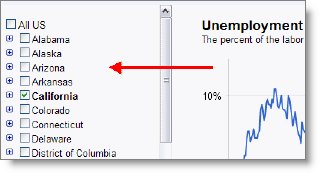
  • Use the checkboxes on the left to add more information to the graph. As you include additional selections, the axes and lines on the graphs may adjust and shift.

    checkboxes

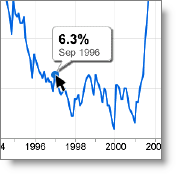
  • Hover over a point on a line to see the point's numerical value.

    hover

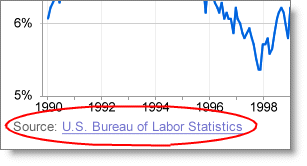
  • It's always good practice to verify a given statistic. To see the source of the data for a given graph, click the link below the graph.

    source link

  • Once you've customized a graph, share it with others. Click Link in the upper-right corner of the page to create a URL which you can then paste into an email or IM.

Have other questions about using these public data graphs? Visit the Google Web Search Forum.

Data sources

The unemployment rate and population data you see in Google come from the U.S. Census Bureau and the U.S Bureau of Labor Statistics. Keep in mind that even the most recent public statistic is a bit old by the time it's published, since it takes time to collect and process data. Information on accessing the original datasets

Want to make your public data more visible?

We are constantly looking to expand the scope of public data that people can find through Google. To learn more about making your organization's data available through the public data feature of Google search, see our information for data publishers.


Monday, April 27, 2009

Libraries Need to Think More Like Trent Reznor

From: http://ericschnell.blogspot.com

I seem to be reading a lot about Trent Reznor as of late. I have been forwarded the "Nine Inch Nails iPhone App Extends Reznor's Innovative Run" article in Wired and a Twitter update from a librarian colleague/former student referenced Digg Dizlog: Trent Reznor.

For those saying "Trent Who?," Reznor is a musician/noisemaker for the group Nine Inch Nails (NIN). He has been gaining accolades for his efforts to make music affordable for the consumer while helping artists earn a living. He has done this by rejecting the major-label system and instead distributing music directly to the public via the Web. Many feel that Trent Renzor represents the future of the music industry.

The Reznor piece that caught my attention was a (15 min) YouTube video of a presentation given by Michael Masnick, the founder of Techdirt. Masnick has distilled Reznor's business model down into a simple equation: CwF + RtB = $$$$.


The "CwF" in the equation stands for Connect with Fans. Using various approaches, like dropping USB keys containing new music in the bathrooms at NIN concerts, Reznor has been able to engage, energize, and get fans excited. He continuously experiments and does new stuff to connect with his fans. Masnick commented that he had to change his presentation as he was building it since Reznor kept coming up with new stuff.

The "RtB" in the equation stands for Reason to Buy. This is where Reznor uses his connection with fans to give them reasons to purchase concert tickets, t-shirts, etc. For example, he also creates special 'box' packages of his products which are considered by NIN's fans to be special and unique. Reznor is giving his followers an opportunity to have something that they feel has a significant value added.

The "$$$$" is self explanatory.

Amid all the discussions about the future of academic libraries, I began musing what academic librarians could possibly learn from Reznor. What I came up with was the following (and half-baked) modified Masnick equation:

CwC + RtU = a dynamic library

The "CwC" in the equation refers to Connect with Community. Academic libraries should constantly thinking and prototyping new ways to connect with our communities. This is not to say that libraries are failing to connect. The challenge is that libraries tend to make a connection and hang onto it well beyond its useful life. We shouldn't be satisfied with how we are connecting today.

What are the next connections out there that will allow academic libraries to integrate the services and resources we offer into the lives of our communities? How many prototypes and pilots can we create and get out there as fast as possible?

Academic libraries must implement ideas that are half-baked and equally willing to let them go when they are not working out. We need to continuously experiments and do new stuff to connect with our communities. We need to be so dynamic that others need to change presentations about libraries since we keep coming up with new stuff. We need to learn how to plan less, prototype more!

I doubt Reznor performed a formal needs assessment, a literature search to see what other were doing, and charged a planning committee for each of his ideas.

While academic libraries are playing around with ways to connect with our communities, the important question that each needs to ask and answer for itself is what are the Reasons to Use (RtU)? An interesting analogy was drawn between libraries and the post office in the report No Brief Candle.
Unless libraries take action, participants cautioned, they risk being left with responsibility for low-margin services that no one else (including the commercial world) wants to provide. An analogy is the U.S. Postal Service (USPS). Its innovative, high-margin services, such as international and overnight delivery, have been taken over by private firms, leaving the USPS largely with its lowest-margin-of-return function: domestic mail delivery
Libraries and the post office do share many similar qualities. The physical access to information was our first class mail service for a very long time. We still have (largely) organizational structures, services, and resources allocated around the organization and delivery of physical information. As technology has improved, our communities have begun to use other pathways to deliver and receive their information (first class mail), be it in physical or digital formats.

As with the postal service, at some point libraries could be left offering services that no other service provider finds of value. We could be 'stuck' offering our equivalent of second and third class mail services. Sure, these services are reasons to use the library, but should we be satisfied in offering lowest-margin-of-return services?

The challenge is that some librarians may actually feel that it is the role of academic libraries to provide lowest-margin-of-return services since those are the ones our communities say they need. Instead, I feel that librarians need to begin identifying our added value services. What are the premium packages and the limited addition services which we can provide to support our communities? How can we create a new organizational models to support these services and the Reasons to Use?

CwC + RtU = a dynamic library

So, do academic libraries need to stop thinking less like a post office and start thinking more like Trent Reznor? I think so.

Should academic libraries be scattering USB drives containing attention grabbing content on the floors of our student Unions during orientation week? Absolutely!

However, we shouldn't do it again next year, let alone the year after that.

Judge Rejects Internet Archive Motion to Intervene in Google Settlement

Posted by:

Publishers Weekly reports: A federal judge overseeing the approval process for the Google Book Search settlement has rejected an attempt by the Internet Archive (IA) to intervene in the action. In a short ruling released today, Judge Dennis Chin wrote that he construed the IA’s letter to the court, filed last week, as “a motion to intervene,” and denied it. “The proposed interveners are, however, free to file objections to the proposed settlement.” Objections and comments must be filed by May 5.

The IA had asked the court to alter the proposed settlement to give other companies that have scanned printed books the same protections regarding orphan works that would be granted to Google under the terms of the settlement. The IA had said it does not want to file an amicus brief, also known as a friend of the court brief, as other parties said they intend to do, and it believes “there are no existing parties in the case that could adequately represent the Archive’s interests, or the interest of other Internet content providers.”

Thursday, April 23, 2009

San Jose rejects porn filters in libraries

A year and a half of debate over filtering pornography out of San Jose public library computers came to a head late Tuesday when the City Council rejected spending money on the technology.

"The fear is not based on fact," said Tina Morrill. "We can use this money to keep our library hours longer."